We read...

To know we are not alone. ~C.S. Lewis~

Showing posts with label review. Show all posts

Wednesday, April 14, 2010

Rebecca

review

Rebecca by Daphne du Maurier
397 pages
Gothic romance
my rating: DDG

This is one of those books that you return to time and again throughout your reading life. When read ‘Last night I dreamt I went to Manderley again’, one of my favourite first lines, I am instantly transported to 1930s England and the house on the coast that I wanted for my own as a teenager reading this for the first time.

The Rebecca of the title haunts the story rather rebeccathan participates in it and there are many of the other characteristics required for a gothic horror story, although it’s probably a bit tame for modern  audiences. It’s a love story in the style of ‘R’omance – there’s not a lot of mushy stuff but there is a deftly handled romance between Maxim, Rebecca’s widower, and his new bride.

She’s the one who dreams about Manderley, the first person narrator, and she’s very easy for a reader to love so go on – give her a go.

Thursday, April 8, 2010

Tomorrow When the War Began

review[7] tomorrow-war-began-john-marsden

rating: VPI


It’s a teen novel about a war that sneaks up on a bunch of teenagers who are camping in the remote countryside of an unnamed country, which I couldn’t help but think of as my own Australia. This, I expect, comes from the Australian-ness of the narrative voice and my knowledge of the origins of the book. I heard John Marsden interviewed somewhere and he said he wrote the Tomorrow books to speak to his students who were disengaged with literature.

I’ve been wanting to read it since my teenagers read it and l.o.v.e.d it to  pieces! It’s an easy, enjoyable read, a bit too teenagerery for me and, while I love the apocryphal storyline, I was bored by the romancey bits – that’s not a criticism of the book I’m rarely a fan of the smelchy, will-he-won’t-he/does-he-doesn’t-he/I’m-so- confused relationship-stuff.

I loved the start of the book - disorientation of coming home a world abandoned by all humanity but found the teenagers amazing feats of cunning a little far fetched. If an aggressor had enough skill to invade, take a whole town captive and create a base of operations  within the space of a week I think they’d be able to round up the stragglers pretty quick too. It didn’t detract too much though & I can see why it would capture the hearts and minds of a youth reader audience and inspire the reading of the whole seven books in the series.

Wednesday, April 7, 2010

84 Charring Cross Road

review[7]

rating : DDG (drop dead gorgeous)

During the Christmas break I started reading Guernsey Literary and Potato Peel Pie Society, one of my Christmas books. It reminded me so much of 84 Charring Cross Road I abandoned Guernsey to revisit 84, a charming book which should be required reading for all book lovers.84 Charing Cross Road An epistolary novel gathering the correspondence (which did actually take place so It’s not really a novel I guess) between Helene Hanff (in New York) and Marks & co - 'antiquarian book-sellers' -  (in London) just after WWII. The lovely pithy little letters make it a quick read.

The juxtaposition of Helen, a fiery New Yorker who writes just the way you’d imagine she speaks, and the very proper English gentleman, Frank Dole, is glorious and their discussion of literature (amongst other things) makes this book a treasure.

Helen, as an anglophile, was a girl after my own heart and her desire to see, taste and feel all things English was something I could relate to in such a passionate way the first time I read this:

Please write and tell me about London, I live for the day when I step off the boat-train and feel its dirty sidewalks under my feet. I want to walk up Berkeley Square and down Wimpole Street and stand in St. Paul's where John Donne preached and sit on the step Elizabeth sat on when she refused to enter the Tower, and like that. A newspaper man I know, who was stationed in London during the war, says tourists go to England with preconceived notions, so they always find exactly what they go looking for. I told him I'd go looking for the England of English literature, and he said:
"Then it's there."

It took us about the same length of time to achieve the dream of walking those London streets – 20 years. Her visit is captured in diary form in The Duchess of Bloomsbury Street, often included now in one volume with 84 Charring Cross Road.

**spoiler alert**

I find The Duchess of Bloomsbury Street disappointing and I realise it’s because it doesn’t contain Frank’s voice.

Monday, March 1, 2010

The Other Boleyn Girl

review

The Other Boleyn Girl Phillippa Gregory
452 pages
historical Fiction
my rating: VPI

Gregory gives life to the court of Tudor England and creates some relatable characters in her book about Mary Boleyn, and its five sequels.  I found myself hating Anne and loving Mary and I think strong emotion evoked in the reader is an indication of good writing.

I love historical fiction and so the VPI rating should be other-boleyn-girl taken under advisement – if you’re not into this genre you won’t like it as there is a lot of history here. The wikipedia entry has a lot about the historical inaccuracies, but you don’t read fiction for  fact. Just read it for the pleasure of the vivid and detailed life of Mary Boleyn. Don’t short-cut this by watching the movie which did not do justice to the book despite the gorgeous Eric Banner as Henry VIII.

Tuesday, February 2, 2010

The 19th Wife by David Ebershoff

[review[7].jpg] 514 pages
Genre: Family Saga/whodunit/religion
Tone: factual/historical
Rating: VPI
Fav lines: We were something else – a cult, a cowboy theocracy, a little slice of Saudi America. p8

First Line: In the one year since I renounced my Mormon faith, and set out to tell the nation the truth about American polygamy, many people have wondered why I ever agreed to become a plural wife.

Synopsis: Interweaves dual stories of a nineteenth wife; one, Ann Eliza Young in 1875, who sets about divorcing her husband and de-bunking the practice of polygamy; and two, BeckyLyn a current-day 19th wife accused of killing her husband who must be rescued by her estranged son, Jordan Scott.

What do I think?: This is a book about families and the pressures we put on each other which of course are compounded for the polygamous family. I was very interested to see how the women in a multiple marriage cope and it has to be said that this story shows both he good and the bad (although perhaps not with equal measure). It’s not what you think, it’s not all LDS bashing in fact one of the aspects I really enjoyed was the focus on faithful people living out their lives according to their beliefs even when the rest of the world can’t understand or doesn’t agree.

I was pleasantly surprised to find that it’s not at all sordid, the voracious way women are ‘consumed’ and then discarded by a few men in positions of power is subtly handled with lots of spaces in the text for the reader to fill in themselves…nice.

Overall I enjoyed both storylines although Ann Eliza gets a bit dry at times. Polygamy is an interesting subject deftly given life in this book, I’d recommend it if you’re interested in the different ways people live their lives.

Saturday, October 31, 2009

The Slap by Christos Tsiolkas

(yes it’s the one I cut into three pieces)
[review[7].jpg] 485 pages
Genre: Family Saga
Tone: smutty realism
Rating: NMP
Fav lines:
Nup didn’t have one
First Line:
His eyes still shut, a dream dissolving and already
impossible to recall, Hector’s hand sluggishly reached
across the bed.

Synopsis: Hector and his wife Aisha invite friends and family to athe slap BBQ and in the course of the backyard cricket match one small child is disciplined by an adult – not his parent – via a slap on the bum. The fall out from this event, told from the the perspectives of eight adults, is the plot of this book.

What do I think? Firstly, no one should take the disciplining of a child out of the parent’s hands even if said parent isn’t doing a good job unless, of course, they are putting the child’s life/health/well being in jeopardy. This is the main social taboo dealt with in The Slap. The others; teenage sex/drug use, adultery, smoking, homosexuality, wife beating, the nanny state, mixed in with the hot button issues of racism, dysfunctional relationships, culture clash & religion combine to create a world with which many will identify.

I didn’t like one single character in this book which made it a hard read for me. I don’t like graphic sex, expletive language or melodrama either, hence the low rating. This is not what the world is like for me and I’m grateful. This book has won a swag of awards…

  • Winner, Overall Best Book the Commonwealth Writer's Prize 2009
  • Winner, ABIA Literary Fiction Book of the Year 2009
  • Overall Book of the Year 2009Winner
  • ABA Book of the Year 2009
  • Winner, ALS Gold Medal 2009
  • Winner, Victorian Premier's Literary Awards 2009
  • Shortlisted for the Miles Franklin Prize 2009 & the Colin Roderick Award 2008
  • so maybe it’s me who’s out of touch but you know what I missed most when reading this book? Australian ideology. Where is the she’ll be right mate laconic sense of humour, where is everyone deserves a fair go? When did we start taking ourselves so seriously?

    Maybe I’m too old to read this new young stuff. I just wanted to get them all together in a room and say get over yourselves and get a bit of perspective…a kid got slapped at a barbie, the adult apologised, it happens, that’s life move on – don’t make me wade through 485 pages of filthy swearing, unattractive sex, unpleasant internal monologues only to fizzle out to everybody living unhappily ever after in soap-opera Australia in the end.

    I would not have read this if it weren’t for bookclub so bookclub is doing it’s job - forcing me outside my comfort zone. It did generate some interesting discussion many really enjoyed it – they must think like the judges who have rewarded this book so handsomely. Hey it’s not the first time I’ve been in the minority!

    Friday, July 31, 2009

    The Best Thing

    The Best Thing by Margo Lanagan
    181 pages
    Genre: YA
    Tone: gritty
    Rating: VPI (well not exactly pleasant but interesting enough).

    Fav lines: Outside the cicadas cease, like a blanket snatched off us, letting in the silence in.
    First Line: I find a condom in my locker, with a jelly baby poked right down the tip.

    Synopsis: Mel is a typical 17 year old full of angst, confusion & awkwardness; she’s dealing with some pretty heavy stuff. Her parents are having marriage troubles & she’s burdened with a secret that could make them worse; she’s got bullies throwing stones at her and putting condoms in her school locker; she’s had one miscarriage and may be pregnant again; she’s got Pug but does she love him?

    What do I think? There’s nothing like a good first person narrative to get you hooked. Poor Mel struggles to work through all her difficulties in a self-imposed isolation that made me want to hug my daughters and tell them that they are never alone. The structure – narrative broken by technical details of pugilism and obstetrics – I found a bit poncy. If I thought about it for a few minutes I could probably come up with a nice form = theme analysis but I just wanted the story in this book (so I skipped a lot of the ‘interruptions’). It is at 181p a very quick read and everyone who knows me knows I’m a Lanagan-fan, so it wasn’t a stretch for me to like this book.

    It’s not like any others that I’ve read of hers. It’s set very much in the real world – places in Sydney that I can picture in my head. I think it would appeal to the YA audience – seems to me Lanagan has captured an authentic voice in Mel. One thing I noticed was how much I rely on my car. Mel doesn’t have access to a car so, being furiously independent she walks everywhere, even when she’s in labour!

    I really like the explanation of the title (something I always like to nail down) which is articulated on p 135 and foregrounds the climax of the story beautifully. Read this for a reminder that life goes on with all its ups and downs. No matter how unsurmountable difficulties seem just keep going and you’ll find one ‘thing’ worth living for – the best thing.

    Friday, July 17, 2009

    Time Traveller’s Wife

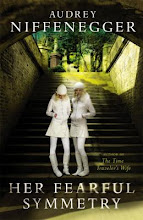
    • The Time Traveller’s Wife Audrey Niffenegger  TimeTravellersWife
    • pp 546
    • Genre: Romance, SF, Speculative
    • Tone: quirky, self deprecating love story
    • Rating: DDG
    • Fav Line: Clare” "It's hard being left behind. I wait for Henry, not knowing where he is, wondering if he's okay. It's hard to be the one who stays."
    • Synopsis: Henry De Tamble suffers from a genetic disorder that causes unpredictable, involuntary time displacements – forward and backward of his own time-line. He just ends up in a different time; disoriented, hungry and naked. He starts this adventurous lifestyle at five years old, it sounds great to have this potential but the logistics of arriving some other time with none of the basics – food, clothing, shelter mean that this is a life only viable for someone young and fit. Henry’s great fear is that something will happen to his feet that will prevent him from running – a thing you have to be very good at to survive his kind of life.

      He meets Clare when he’s 28. He’s never seen her before but she’s known him since she was a little girl finding him, a grown man, naked, hiding in the bushes near her home. Confused? You’ll have to read it, it is well worth picking up, you’ll read the first chapter and be totally hooked!

    What do I think?

    Described in the blurb as an ‘unconventional love story’ it was the ‘unconventional’ that attracted me. I find it very curious that this book was Niffenegger’s response to her own lacklustre love life, a metaphor for her failed romances.

    Genre-wise it’s been placed in both romance, science fiction but I read it as speculative fiction because that’s what interests me. The premise: a man with a genetic disorder that makes time travelling an unpredictable part of his life falls in love, marries and is accepted as ‘normal’ within his circle of friends and acquaintances intrigued me.

    I love the structure, alternating first person perspectives following Henry and Clare as they make sense of their lives. Each new section is dated giving the ages of Henry (which can vary according to ‘when’ he is) and Clare. I can’t imagine how Niffenegger plotted this story or kept all the time-lines in her mind. You may feel tempted to keep track of what’s happening and when (I did) so for example when Henry is ‘chrono-displacing’ (the name of his disorder) you know something about what’s happening in Clare’s timeline.

    Henry runs into himself when he travels too...I love it...the idea of his older self being the one who explains to his five year old self what’s happening when he time travels and how to cope with it is fantastic. This is refreshingly original from a speculative point of view, this is a world where you can meet yourself without dissolving as in so many other time travelling narratives (think Back to the Future).

    Henry is a runner, he needs it to help him manage his stress levels (stress is a trigger for time travelling). If he wants to stay in Clare’s present for something special like their wedding- day from example he needs to run every day. Henry’s demise is foregounded when he explains to Clare how important his running is to him, it makes his return from one ‘trip’ with frostbitten feet amazingly poignant.

    Thursday, May 28, 2009

    take it or leave it but I know Freda so this was a MUST read

    review

    Freda: A Biography of Freda Whitlam by Noelene Martin
    Length: 319 p
    genre: biography
    Tone: conspiracy
    Rating: **Shrug**

    Fav lines: For moments like this, I always kept a supply of books that I had read before on hand. They included dome children’s books, but all were books I had previously enjoyed. I knew when I read them again, they would lift my spirits. p267freda

    Freda has lived an amazing life and not just because she was the sister of the Prime Minister of Australia, although she did enjoy some perks that went with that relationship. She studied at Yale, spent missionary-time in France, was the principal of PLC Croydon for 19 years, and was a leading light the Uniting Church. She speaks at least for languages, has multiple degrees including an honorary doctorate from the university she helped establish – UWS.

    She has had great highs – travelling the world, meeting important people Indira Ghandi for example and great lows usually at the hands of the unscrupulous or the petty-minded. Some of the lows she’ brought on herself but equally she can claim to having made the highs happen too for if nothing else Freda is an independent woman.

    Knowing all of this make me feel a voyeuristic because Freda goes to my church and sits on several committees with me. Like many who meet her I’ve at times been a bit intimidated by her intelligence and position. At other times I’ve been angered by her handling of certain situations and then again I’ve rejoiced at having her in our midst because she is wise and clever and willing to lead. But now all of these responses fall into place because, after reading this book, I feel I know her a little better (or a little too much).

    Not being a fan of the genre It’s hard to judge how this book sits within the context of biography. I know the author too and while I think Noelene did a great job capturing Freda ‘warts and all’ I think her editor let her down. Maybe I have expectations too high in this day and age of texting and general mutilation of the language but the syntax is just too lax, there’s some typos and there’s some jarring subject leaps that detract from the overall cohesiveness. This is a pity because Freda’s story is an interesting one…from the jacket blurb ‘she has been a leader in education and the Church, a leader of women and a force to be reckoned with in Western Sydney…pithy, witty, intimidating, sometimes eccentric’ Freda will inspire you so I’d recommend this if you like biographies and are not too much of a pedant about the writing.

    Saturday, May 9, 2009

    VPI

    Disquiet by Julia Leigh
    121 pages
    Genre: Family saga
    Tone: quirky macabre
    Rating: VPI (well not exactly pleasant but intriguing)

    Fav lines: She shed her dress. Stepping forward, she incrementally immersed herself in the icy water, the lake close like a glove. Vile baptism.

    First Line: They stood before the great gateway, all around an empty and open countryside, ugly countryside, flat mud-ploughed fields.

    This book was on my RBF (recommended by friends) TBR pile, thanks to Renae for a 'you must read this'. It was an easy one to knock off the list, a read in one session read. It is, however, not at all easy to dismiss in a finished-one-move-on-to-the-next kind of way. Rather it’s one of those short stories that stay with you, hauntingly.

    In such a limited word count economy is necessary so, while the words tell the story, the melancholy of a deeply flawed family is deftly evoked in the silences. The opening line sets the scene anywhere, anytime providing no context for the reader to sit comfortably and thereby, positions the reader in unsettled ‘disquiet’ which is further developed in the unnerving unravelling of the narrative. Alliteration of great gateway highlights the obstacle while emotive words, ‘empty’, ‘ugly’ and ‘flat’ set the somewhat gothic mood.

    In the next couple of sentences we see the children are wearing backpacks and the woman can’t access the gate’s palm-pad entry, so we recognise a modern temporal space but the place is still unknown. After forcing an entry to her family home, breaching a secret gate in somewhat heavy-handed symbolism, the woman and her children are introduced to the readers as they are introduced to her estranged family. Olivia has returned home ‘I needed to come home’ as a prodigal but her brother returns home clearly as the favourite.

    Marcus comes through the front door, bringing his obviously upset wife and their dead baby with him. Yes, that’s right I said dead baby. It seems that the pair have come from the stillbirth of their child to the family estate to mourn and bury their child – Alice. So here’s were the quirky comes in…Sophie carries Alice everywhere. In the evening they make a nice bed ‘we have to make it – comfortable’ for her in the freezer (to stave off decomp), and Sophie suckles Marcus (her husband) to deal with her unnecessary lactation.

    Family, the strange and glorious things we do to one anther, is a strong theme throughout this story. Husbands and wives, brothers and sisters, mothers and children all have repeating and richly symbolic storylines. One mother has come to set her affairs in order both by reconciling with her own mother thereby securing a future for the children. As a battered wife she has given up on her own future, refers to herself as ‘murdered’ rather than preparing for suicide. As readers we are distanced from her through the device of ‘the woman’. She is only ever referred to as Olivia in conversation with other characters. As the narrator interacts with reader she is simply the woman. Her melancholy stems from the thing that cannot be mourned – her dead marriage to an abusive husband who looms ominously just out of frame.

    One mother has come to bury her dead baby. This is her sadness, her misery, but her melancholy is a deeper thing. Melancholy is, by definition that which cannot be mourned and for Sophie it resides in the adultery of her husband. This ‘other’ looms large too through the intrusiveness of mobile phones and the ‘crazy lady’ on the other end of the line.

    The third mother must welcome home; a daughter, broken by ill-advised choices; a son, who has a child but is not a father; grandchildren 9 and 11, whom she has never met and one who is dead. Watching them all make sense of their lives is riveting reading.

    Wednesday, April 29, 2009

    Drop Dead Gorgeous

    Well here goes, thanks to your encouragement and this fantastic book, which I can't stop talking about, here is my first review...


    The Handmaid's Tale by Margaret Attwood


    What did you do this morning? Hit the snooze button for just five more minutes? Shower? Shave? Make-up? Did you fit breakfast in or did you just poor a cup of strong coffee in your thermal travel mug and hit the road? When you read Margaret Attwood’s The Handmaid’s Tale, all the little drudgeries of life suddenly become pleasures.

    That’s when you know you’ve got a powerful story in your hands – when it impacts your daily life.

    When I skipped breakfast I actually felt privileged, because Offred couldn’t do that. In her world, the world of Gilead so delicately drawn by Attwood, everyone has their set role with its own clearly defined freedoms and restrictions. Offred is a Handmaid and as such cannot decide to skip a meal, she must stay healthy in order to bare children in a world of extreme negative population growth.

    Offred does not say ‘mine’ anymore. She has a room, clothes, plenty of food but no life beyond her assigned task of pregnancy. This she has been schooled to accept, as the ‘possession’ of Fred and his wife. She does not have her own name she is simply Of Fred. She cannot choose what she will wear her red summer dress will be replaced by her red winter dress on a certain date and not before. This task will be undertaken by the Marthas – the group of women designated ‘help’. As a handmaid Offred does have certain freedoms; she can walk in the open air to do the household shopping, albeit with the company of another handmaid, they can choose which route to take. She has the freedom of her thoughts and this gives her some control.

    ‘If this is a story I’m telling, then I have control over the ending.’ P49

    This self-reflexive extremely close first person point of view colours and constructs the unsettling nature of The Handmaid’s Tale.

    From the safety of inside her own head we have her story. We follow her thoughts, although not strictly speaking stream-of-consciousness, as she tells us what she sees, feels and remembers. We jump from distant past, recent past and present with no warning, dropped as we are unprepared into Gilead. It’s disconcerting but purposeful. Our confusion mirrors Offred’s own.

    Piece by artful piece we hoard clues in an effort to make sense of this anarchic place and post nuclear devastation time. It is a place of no relationships/friendships/trust. A place tightly controlled where fear and lack of information is used to create and maintain that control. I’ve just watched a doco on North Korea and there were some really scary similarities.

    It is broken into 15 sections, the titles of which are a wonderfully clever clue to Offred’s world.
    1. Night
    2. Shopping
    3. Night
    4. Waiting Room
    5. Nap

    These clipped concise words reflect the abruptness of a world reduced to the bare necessities.

    World building is an essential part of Speculative Fiction – for this is most certainly the genre. Attwood’s world building is subtle and ingenious. Using form to reflect meaning she at once unsettles and entices the reader. I could not wait to find out how the world got this way, but I had to wait to chapter 28/46, almost half way through the book. With its Anthropological appendix it is an innovative and compulsive read.

    The Handmaid’s Tale, like it’s forerunners; Orwell’s Nineteen Eighty Four, Huxley’s Brave New World, Wells’ The Shape of things To Come, presents a dystopian future for our race, one that is eerily plausible. As we watch our civil liberties disappear in a myopia of protectionism, as THEY become ever present in our news-casts, as we become more entangled in the ‘grid’ of surveillance, places like Gilead seem not at all farfetched – which is not good because, as knowledge is power, books are banned there.


    my rating: DDG (Drop dead Gorgeous! Go out and get it, put some time aside, you won't be disappointed)